Safe to Learn, Bound to Lead Respectfully
How does a hierarchical environment affect our ability to say “no”? And why does the academic environment still lack clear rules of conduct between people that are common in other professions? We have commemorated this years International Day of Women and Girls in Science celebrations with online social media campaign focused on the issue of hierarchy, power, and consent, as well as problematic relationships in academia.
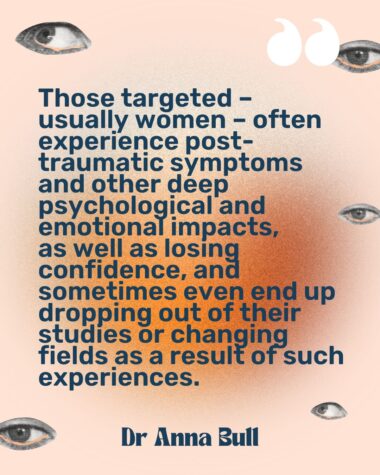
On February 2, a two-week communication campaign entitled “Safe to Learn, Bound to Lead Respectfully” began. It drew attention to the urgency of the issue of problematic relationships and professional boundaries in academia, offered support materials and methodologies available in Czechia in this area, and shared data and the inspiring work of Dr Anna Bull, whose visit to Czechia was the highlight of this year’s celebrations.
Quotes from experts involved in higher education and scientific institutions published on Instagram, Facebook, and LinkedIn drew attention to the need to address safety, consent, and professional boundaries at universities.
Who participated in the campaign?
- Kateřina Šámalová, Charles University Ombudsperson whose social media accounts are currently running the #YouAreNotAlone campaign focused on safe academia
- Dita Jahodová, representative of the School Ombuds Platform and ombudswoman at the Czech Technical University in Prague, who contributed to a major statement on Close Relationships on Academic Grounds (2025),
- Matouš Glanc, director of Czexpats in Science,
- Dr Anna Bull, University of York and co-founder and director of The 1752 Group.
As part of the campaign, we also published an interview about a courageous testimony and case at the Institute of Physics of the Czech Academy of Sciences, where in 2024 Dr. Hana Lísalová drew attention to problematic behavior on the part of Professor Jiří Homola.
While professions such as medicine, psychology, and social work often have clearly defined codes of conduct regarding interpersonal relationships, academia often lags behind. “Universities have an ethical and legal responsibility to ensure a safe environment for study without predatory behaviour,” says Dr Bull, adding that “where colleges fail in this area, student activism can bring about change. And it does bring about change when it points out the hypocrisy of universities that protect (usually) male academics from women, LGBTQA students, and younger staff.” This is confirmed by the Czech experience with many cases of gender-based violence, the problematic nature of which has been highlighted by student initiatives.
Practical Help Over Theory
The campaign also aimed to draw participants to an open discussion with Dr. Anna Bull, which took place on Thursday, February 12, 2026, at the Faculty of Arts, Charles University. We reported more on the event here.
Dr Anna Bull is a director of The 1752 Group, a research and campaign group addressing sexual misconduct in higher education. Dr Bull has published numerous reports on gender-based violence in higher education and is an international expert consultant. The social media campaign also highlighted her work. In 2021, the professional journal Times Higher Education named Anna Bull one of the “People of the Year 2021,” stating that her research “contributed significantly to the understanding of the problem” of sexual harassment at universities.
As part of our communication campaign, an interview with Dr. Anna Bull was conducted on the topic of close relationships and the responsibility of higher education and research institutions, which you can watch on our YouTube channel.
The International Day of Women and Girls in Science, which falls on 11 February, celebrates female researchers and students and highlights the need to ensure that women and minority groups have full and equal access to and participation in research. Although women make up half of the world’s population, they continue to be disproportionately underrepresented in research and often encounter invisible barriers.
For this year’s celebration of girls and women in science, the United Nations announced the theme ‘From Vision to Impact.’ Gender and Science also has a vision it would like to turn into reality within the Czech academic environment: a vision of a safe academy where every student or early-career researcher is not a victim of toxic behaviour, is able to set boundaries without fear of potential retaliation, and finds support if they need it.
Commemorating 11 February as International Day of Women and Girls in Science is essential not only to celebrate the achievements of women scientists, but above all to critically reflect on the environment in which they work. True equality, not only in academia, requires more than just motivating girls to study—it requires systemic changes that ensure that universities and research institutions are safe, fair, and inclusive spaces for everyone, without distinction.